Restaurant owners open their monthly P&L reports, look at sales, then go down to the bottom and close the report.
Do you recognize the sound?
If just those two numbers are scrutinized, the report’s true value is lost.
It shouldn’t make them more dependent on an accounting firm. They should be more confident in their own financials. You don’t need to be an expert in accounting or spend the night entering invoices. You must be aware of the reason why profits moved from food and labor costs and which issues require focus next week.
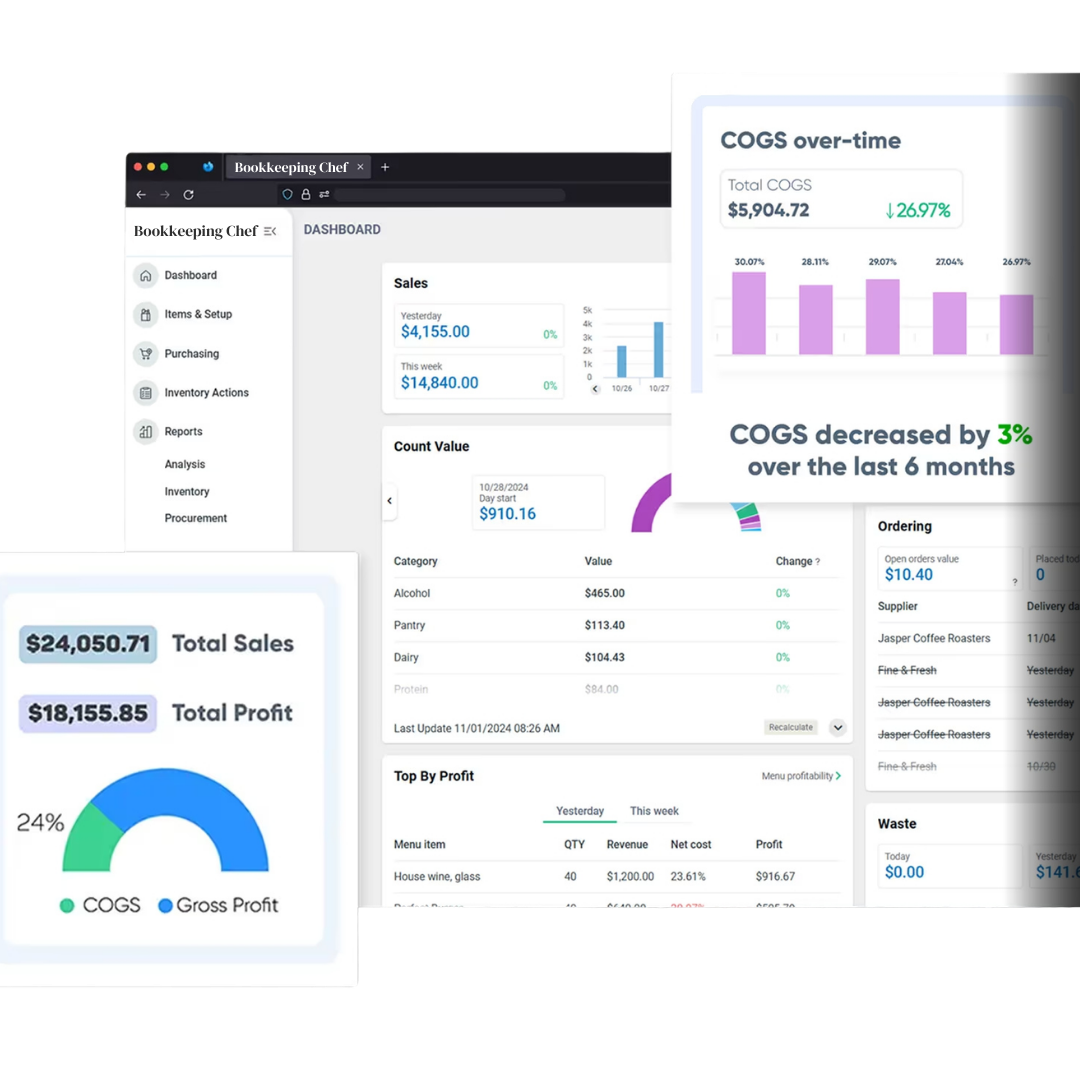
Bookkeeping Chef’s goal is to automate bookkeeping tasks that do not require the time of restaurant owners, while providing them with clearer financial data they can use.
You should begin by looking at the Weekly Numbers and Not just Month-End
Restaurants do not operate on a monthly basis. The managers plan the work for the week. Chef orders food now. Vendors change prices now.
Bookkeeping Chef offers weekly flash reports on the top costs, together with monthly financial reports.
The prime cost comprises two major areas that are easily transported in a restaurant establishment: cost of the goods that are sold, as well as labor. According to the data offered by Bookkeeping chef, prime costs make up around 60% of sales in restaurants.
Imagine that sales have barely changed, but the prime cost rose. The percentage alone does not give the answer. It gives the owner a reason to look into the issue.
Did hourly work grow? Did you have an overtime? Did food cost move? The invoice of a vendor was unusually high. Have the sales mix changed?
This is much better than finding the same problem several weeks later.
Automate the repetitive Work
Self-bookkeeping doesn’t mean manually transfer of POS numbers into spreadsheets.
Modern bookkeeping automation in restaurants can handle a significant portion of the routine flow of financial data. The service integrates systems such as POS as well as QuickBooks payroll vendor platforms and inventory management.
The aim is not to automate for its own sake.
The goal is to eliminate the need for manual data entry and ensure that financial records are up-to-date so that owners are able to spend more time analyzing the information rather than assembling it.
This is a completely new way of bookkeeping in restaurants. The technology handles more of the mechanical aspects, but the owner is still tasked with the financial implications.
Learn to ask the P&L Better Questions
Stop thinking of your P&L as the accounting test.
Begin by looking at the sales. Next, look at the expenses necessary to achieve those sales. Compare the food and drink performance. Analyze the costs of labor. Keep working to cut down your operating costs.
Also, you should compare the time periods.
When sales improve but profits aren’t, it is a change between them. If food prices increased, ask what happened operationally. If the labor rate changed, compare staffing and sales activity. Investigate if a number seems strange, instead of assuming that the restaurant experienced an unfavorable time.
Bookkeeping Chef offers monthly P&Ls finalized within five business days. This provides owners the chance to examine recent results rather than receive accounts long after the operating period has ended.
For owners searching bookkeeping restaurant solutions, speed is useful but understanding is the bigger objective.
You don’t have to take on everything by yourself by doing it yourself
It is not necessary to be the sole bookkeeper to avoid handing the complete financial responsibility over to another person.
Owners can still be involved in the accounting process without needing to do everything by hand.
This could mean the use of automated systems to keep track of information flow, looking over the monthly P&L and weekly reports regarding prime expenses, or asking questions if there is an unplanned event.
Restaurant bookkeeping services that specialize in restaurant bookkeeping can help proprietors get the most from the reports by organizing the books and keeping them organized.
It is unlikely that you’ll have a bookkeeper who can perform all the functions.
An owner is someone who can have a conversation with an P&L about the business.
The objective is financial freedom without reporting
Restaurants already produce huge amounts of information. Another dashboard might not be beneficial.
When an operator has the ability to take a look at their weekly report on prime costs and discover that something has changed, they are able to then access their P&L to look into what’s required for an investigation.
Bookkeeping Chef’s plan incorporates automation of bookkeeping in restaurants daily reporting and monthly P&Ls. the financial support for specific restaurants to make that possible.
Automate the repetitive work. Examine your prime cost each week. Learn to speak the same language as your P&L.
You do not have to be an accountant.
You must be an owner who is aware of the financial story behind your restaurant.